Crane (tsuru) — who is it in Japanese mythology
Tsuru is a crane, and Japanese mythology has made it a symbol of longevity and gratitude. It is the hero of the tale 'Tsuru no Ongaeshi', where a rescued bird turns into a woman and weaves magical cloth from her own feathers. A thousand folded paper cranes, senbazuru, is believed to grant a wish — this tradition became known worldwide thanks to the story of Sadako Sasaki.
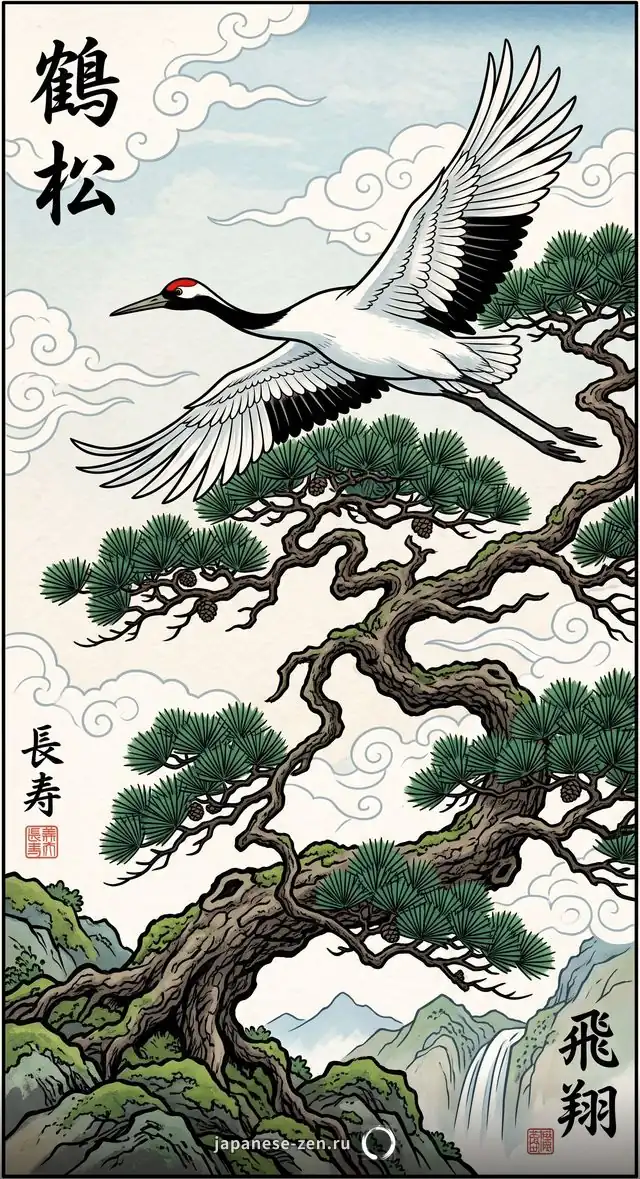
In Japanese culture, the crane is not so much a mythical creature as a polite symbol: a bird about which stories of gratitude are told, not of feats and battles.
What the crane symbolizes
Tsuru is a crane, a symbol of longevity (believed to live a thousand years) and gratitude. It is traditionally depicted alongside a turtle — 'tsuru-kame' — a stable symbol of long life on New Year's cards and wedding gifts. The main story about the crane is not a creation myth, but a folk tale about the gratitude of a rescued creature.
- Symbol: longevity, fidelity, gratitude.
- Pair: depicted together with a turtle in New Year's and wedding symbolism.
- Main tale: 'Tsuru no Ongaeshi' — a crane-woman weaves magical cloth in gratitude for being saved.
- Origami: a thousand folded cranes, senbazuru, grants a wish.
How the crane responds to kindness
It is completely harmless — a rare case in the Japanese bestiary where a character is entirely positive. The only condition in the tales is not to break one's word: a husband who spies on his weaving crane-wife against her prohibition loses her forever.
鶴 — one character, one reading
| Japanese | Reading | Translation |
|---|---|---|
| 鶴つる | tsuru | Crane |
| 鶴の恩返しつるのおんがえし | Tsuru no Ongaeshi | 'The Crane's Gratitude' — title of the tale |
| 千羽鶴せんばづる | senbazuru | A thousand paper cranes |
| 鶴亀つるかめ | tsurukame | 'Crane and turtle' — symbol of longevity |
| 恩返しおんがえし | ongaeshi | Repaying kindness with kindness |
Why 鶴 is read in only one way
鶴 is read つる (tsuru) without additional readings — a rare case of a simple, unambiguous character. It is also part of 千羽鶴 (senbazuru) — a word known far beyond Japan today thanks to the tradition of folding a thousand cranes with a wish for peace.
- Meaning
- crane, stork
- Onyomi
- カク
- Kunyomi
- つる
- strokes
- 21
鶴 — 'crane': on the right is the radical 'bird' 鳥. The same radical appears in 鳥 (bird) and dozens of names of feathered creatures.
Where the crane is visible in today's Japan
- Hiroshima Peace Park — millions of folded senbazuru cranes are brought there annually in memory of Sadako Sasaki, a girl who folded cranes hoping for recovery.
- Wedding ceremonies — the tsuru-kame image remains a standard wish for a long life together.
- Japan Airlines logo — a stylized crane tsuru-maru, one of the country's most recognizable brands.
- Sanctuaries in Hokkaido — the Japanese crane, a protected species, actually lives there.
FAQ
Is the crane a sacred bird or just a symbol?
Not a deity, but a symbol of longevity and gratitude — the hero of the tale of a rescued bird that turns into a woman. There is no mythological cult of the crane as a separate god.
What does the crane symbolize in Japan?
Longevity, fidelity, and gratitude. Paired with a turtle, tsuru is traditionally wished for a long life at weddings and on New Year's cards.
How do you write 'crane' in Japanese?
鶴, read つる (tsuru) — a simple, unambiguous reading with no variants. The same character appears in 千羽鶴 (senbazuru) — a thousand paper cranes.
Can the crane cause harm in tales?
Definitely kind: in the main tale, the crane-woman sacrifices herself for gratitude to her savior, weaving her own feathers into magical cloth.
Where does crane symbolism appear in anime?
Tsuru symbolism often appears as a cultural detail — at weddings, in New Year's scenes, or as a metaphor for a character's longevity, not as an independent plot hero.
How is the crane different from other symbolic birds of Japan?
Unlike the yatagarasu crow, which serves as a guide of the gods, tsuru is an exclusively peaceful symbol of longevity and gratitude, without a religious or mythological guide function.
Sources
Updated: