Torii — what is this place and why do people go there
Torii (鳥居) are Π-shaped gates made of two pillars and one or two crossbeams that mark the entrance to a Shinto shrine. Passing through them symbolically moves you from the ordinary world into the space of kami: the closer to the main hall, the shorter the path between successive torii. Red is not the only color, but it is the most recognizable.
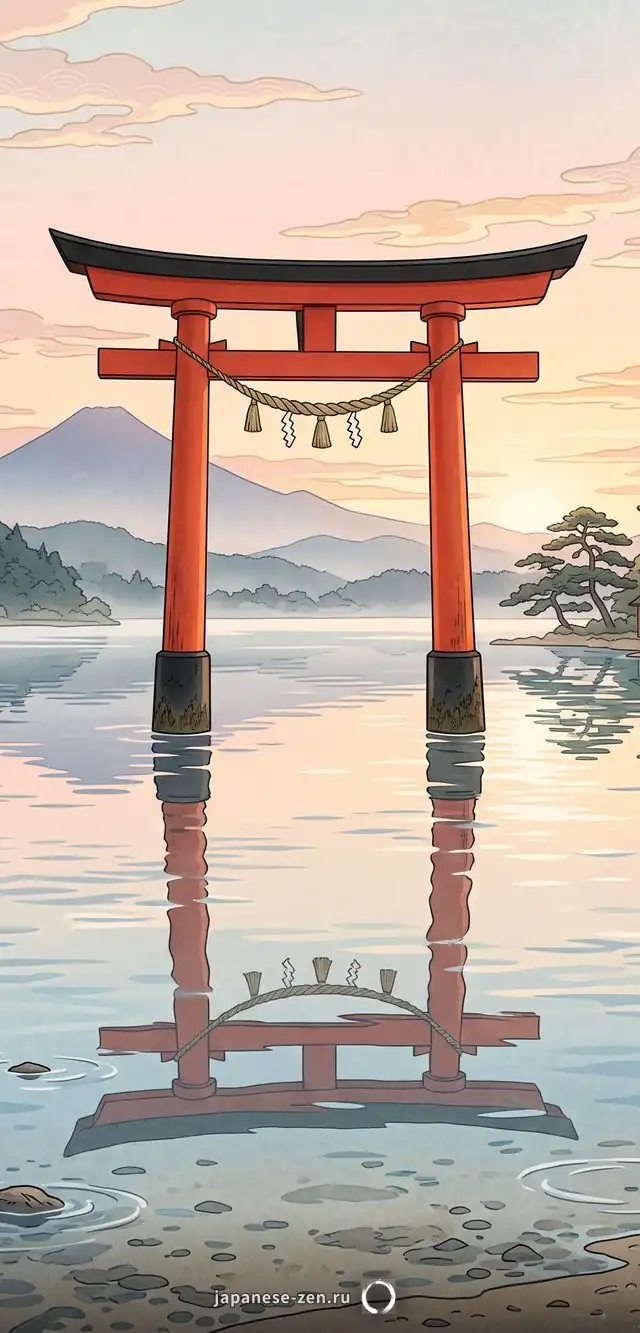
A torii looks like a simple frame without walls or a roof. Its sole function is to mark the boundary beyond which the street ends and the deity's territory begins.
What is a torii
A torii is a gate made of two vertical pillars and one or two horizontal crossbeams, without doors or walls: you can walk through from any side, and no one checks a ticket. They are placed at the entrance to a Shinto shrine, and sometimes in a whole avenue if the path to the main hall is long.
- What it looks like: two pillars, the top crossbeam (kasagi) often curves upward at the ends, the lower crossbeam (nuki) is straight.
- Material: wood or stone; painted wood is usually cinnabar red, but unpainted and black versions also exist.
- Number: large shrines may have several torii in a row, marking stages of approach to the altar.
- What's inside: beyond the torii is the territory of kami, so special rules of behavior apply.
Why people go to a shrine
People go to a shrine to pray for something specific — health, exams, a good marriage — to buy an omamori amulet, or to toss a coin and clap their hands before the altar. Tourists come without a religious purpose, just to see the architecture and, if the shrine is famous, the long avenue of red torii.
Name and characters: 鳥居
| Japanese | Reading | Translation |
|---|---|---|
| 鳥居とりい | torii | Torii, shrine gate |
| 鳥とり | tori | Bird |
| 神社じんじゃ | jinja | Shinto shrine |
| 赤あか | aka | Redthe most recognizable color of torii |
| 参道さんどう | sandō | Approach path to a shrine |
鳥居 — the place where a bird sits
鳥居 consists of two characters: 鳥 'bird' and 居 'to dwell, to be'. Literally — 'the place where a bird sits': according to one theory, the gate originally served as a perch for sacred messenger birds. The etymology is debatable, but this version has become established in popular explanations.
- Meaning
- bird, chicken
- Onyomi
- チョウ
- Kunyomi
- とり
- strokes
- 11
鳥 — 'bird': the same character appears in 白鳥 'hakuchō', swan, and in 鳥肌 'torihada', goosebumps, literally 'bird skin'.
How to behave at the gate
- Before entering, bow slightly to the torii — a sign of respect for the boundary.
- Walk along the edge of the sandō path, not down the center: the center is traditionally considered the path for the deity.
- At the temizuya basin, rinse your hands and mouth with the special ladle before proceeding to the hall.
- At the altar, toss a coin, bow twice, clap twice, make a silent wish, and bow once more.
- When leaving, bow slightly to the torii again — the exit from the territory is also marked with a gesture.
What not to do at a torii
- Taking photos while hanging on the pillars or climbing onto the base — it's not an amusement park attraction but a religious structure.
- Walking strictly down the center of the path from start to finish — locals don't do this, leaving the middle for kami.
- Eating or drinking right at the altar — there is usually a designated area for that, if it is allowed at all.
- Confusing any similar structure with a torii: the gates of a Buddhist temple (kabuki-mon, sanmon) are constructed differently and have a different meaning.
Torii in anime and games
- A lone red torii on a hill or by the water is a common visual for a scene of encountering a spirit or deity.
- An avenue of dozens of torii in a row is a recognizable backdrop for a magical transition between worlds in fantasy stories.
- A torii without a surrounding fence, standing right in the middle of a forest, is a technique that emphasizes the boundary between the familiar and the mystical.
- Ruined or leaning torii are a visual code for an abandoned, forgotten shrine in horror scenes.
Why artists love this image
The simple Π-shape is read instantly and needs no caption saying 'portal here' — the architecture itself signals the boundary between worlds, making the torii one of the most frequent visual markers of the supernatural in Japanese animation.
FAQ
What is a torii?
A gate made of two pillars and crossbeams without walls or doors, marking the entrance to a Shinto shrine. Passing through it symbolically moves you into the space of kami.
What are torii for?
To mark the boundary between the ordinary world and the deity's territory. Large shrines may have several in a row, marking stages of approach to the main hall through a forest or mountain.
How do you write 'torii' in Japanese?
鳥居, in kana とりい. The first character 鳥 means 'bird', the second 居 means 'to dwell, to be'. According to one theory, the gate originally served as a perch for sacred messenger birds of the gods.
What is the difference between a temple and a shrine?
A shrine is Shinto, with a torii at the entrance; a temple is Buddhist, with gates of a different construction, called sanmon. Both are often rendered as 'temple' in English, but they belong to different religions and have different architecture.
How should you behave at a torii?
Bow slightly before entering, walk along the edge of the path rather than down the center, and don't use the gate as a prop for climbing stunts. It is a religious structure, not an amusement park attraction.
What do torii mean in a scene?
In almost any story about encounters with spirits or gods: a lone torii on a hill or a long avenue of them is a standard visual marker of the boundary between the ordinary and the supernatural world.
Sources
Updated: