What does a haori look like
A haori looks like a short, straight jacket worn open: the front panels do not overlap, the length is from hip to knee, and it is held in place by a pair of silk cords called himo at the chest, not by a belt. It is worn over a kimono for warmth, status, or simply as an outer layer of an outfit.
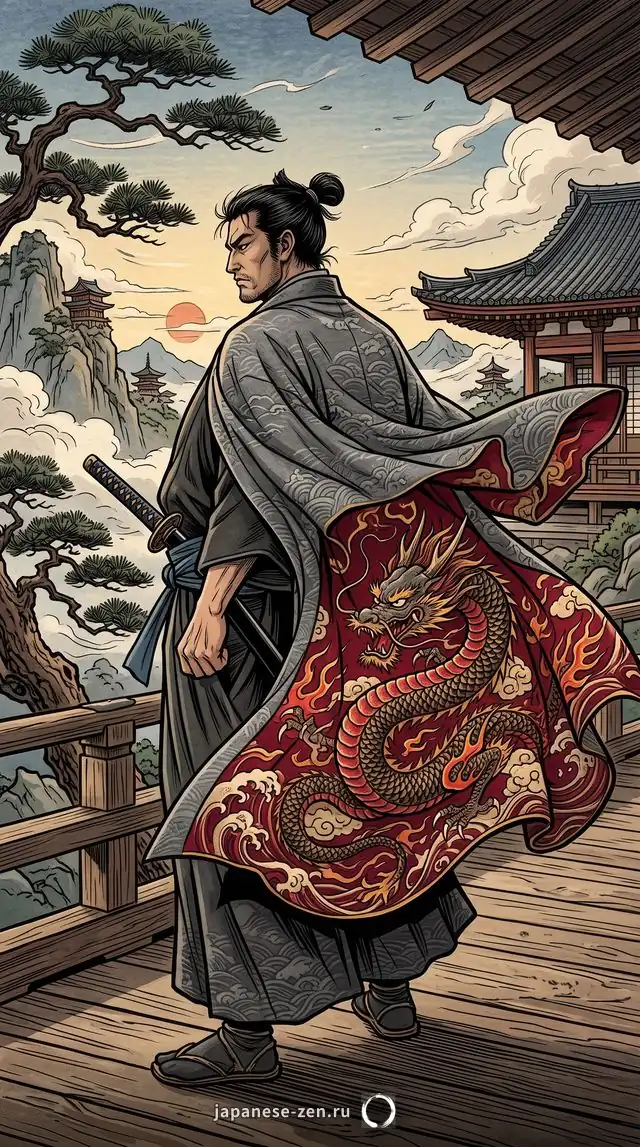
A haori is easily mistaken for a short kimono. The difference is in one detail: it is never wrapped closed and is never worn alone, without a kimono underneath.
How a haori is structured
A haori is a short, straight jacket worn open: the length is from hip to knee, with wide sleeves like a kimono, but without overlapping front panels and without a belt. It is held in place by a pair of thin silk cords called himo, which simply connect the front panels at the chest, rather than cinching the figure.
- Himo — a pair of cords at the collar, the only fastener of a haori.
- Uraji — the lining; often fancier than the outer fabric, where an expensive pattern was hidden.
- Kamon — family crest; on the most formal haori there are five: on the chest, back, and both sleeves.
- Sleeve — wide, straight, without cuffs, sewn the same way as a kimono sleeve.
When it is worn today
The most formal version is a black montsuki with five crests: it is worn by a guest at a wedding or official reception, together with hakama. An everyday haori is colorful, with a small pattern, and without crests. Today, it is also worn separately from a kimono, as a light jacket over regular clothes — this is a stylization, not a tradition.
Name and characters: 羽織
- Meaning
- weaving, fabric
- Onyomi
- ショク、シキ
- Kunyomi
- お.る、お.り、おり、-おり、-お.り
- strokes
- 18
織 — “to weave”: the second character in 羽織 and in 織物 “fabric, textile”. The same root is in 組織 “organization”: both fabric and structure are “woven” from threads.
| Japanese | Reading | Translation |
|---|---|---|
| 羽織はおり | haori | Short jacket |
| 紐ひも | himo | Cord, string |
| 袖そで | sode | Sleeve |
| 背中せなか | senaka | Back |
| 帯おび | obi | Kimono belt (a haori does not have one) |
羽織 — woven plumage
羽織 is 羽 “feather” plus 織る “to weave”: roughly “woven plumage”, a hint at the lightness of the fabric that opens as you move, like a wing. The verb 羽織る specifically means “to throw on a haori” and is not used for other clothing.
Haori in anime and dramas
- “Demon Slayer” — the pattern on the haori serves as a character’s calling card, each one unique.
- A teacher or mentor in school anime often wears a haori over everyday clothes — this is how the status of a senior is depicted.
- In historical films, a haori with five crests is worn in the most formal scenes: weddings, audiences, funerals.
- In modern series, a haori is sometimes worn without a kimono — over a T-shirt, as a fashion statement rather than a historical costume.
How to tell a haori from a jacket
A haori is confused with a regular jacket because of its straight cut and open front. It is easy to tell them apart: a jacket has a zipper or buttons, while a haori has only a pair of himo cords, and not always even those.
FAQ
What does a haori look like?
A short, straight jacket worn open, from hip to knee, without overlapping front panels and without a belt — held in place by a pair of himo cords at the chest. It is worn over a kimono.
What is a haori?
An outer layer of Japanese attire: a light jacket worn over a kimono for warmth or status. Traditionally, it was not worn alone, without a kimono underneath.
How is a haori different from a kimono?
A kimono is always wrapped closed and held in place by a stiff obi belt, while a haori is worn open and without a belt, only with cords. A detailed comparison is in the separate article “kimono and haori”.
What types of haori are there?
From the most formal montsuki with five crests to the everyday komon with a small pattern. Formality is determined by the number of crests and the fabric, not the color.
How is “haori” written in Japanese?
It is written 羽織 and read “haori”: 羽 “feather” plus 織る “to weave” — roughly “woven plumage”. The name hints at the lightness of the fabric and the open cut, which is held in place by a pair of cords rather than a belt.
Is a haori worn today?
As part of traditional attire — at weddings, tea ceremonies, and Shinto festivals. As a fashion item — even without a kimono, over regular clothes.
Sources
Updated: